 how-to
Signs Your Boiler Needs Professional Repair: 2026 Guide
Table of Contents
- Common Warning Signs Your Boiler Needs Professional Repair
- Signs of Carbon Monoxide Leak: When to Act Immediately
- Why Your Boiler Needs a Gas Safety Cert and Annual Service
- Boiler Service Cost: What Affects the Price You Pay
- Repair or Replace? How to Decide
- When to Call a Professional: Emergency vs Routine
- Frequently Asked Questions
Last Updated: 26 September 2026
Common Warning Signs Your Boiler Needs Professional Repair
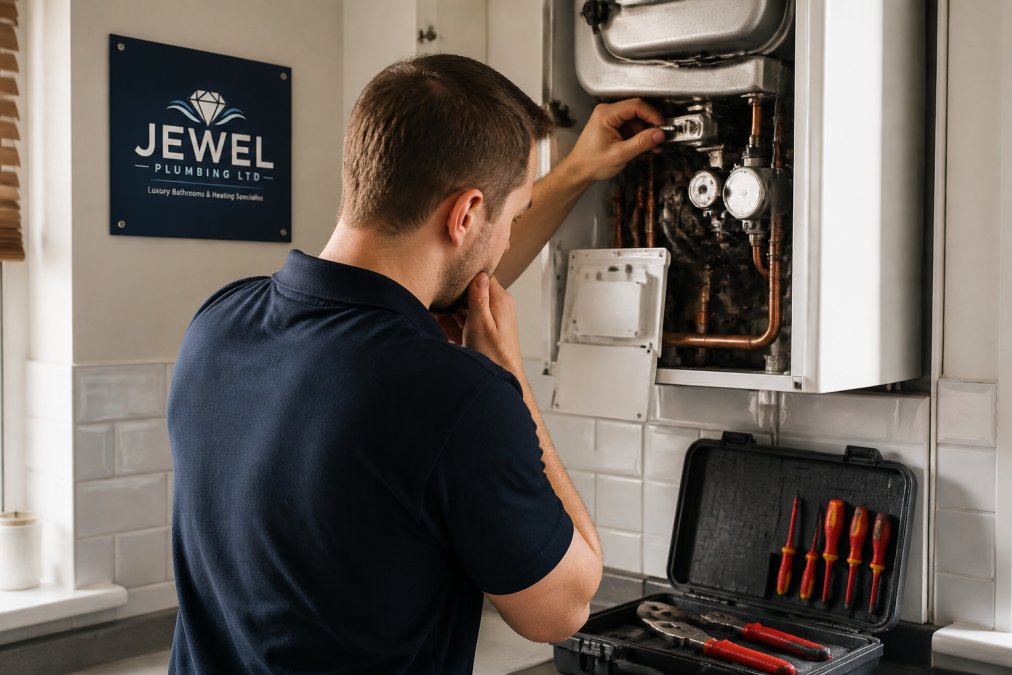
Most boilers do not fail without warning. They complain first, and the homeowners who catch those complaints early avoid the worst of it. Knowing the signs your boiler needs professional repair is what separates a cheap fix from a cold house in January. This guide from Jewel Plumbing covers what to listen for, what to check, and when to stop touching it yourself.
A boiler is a sealed system that heats water and moves it around your home. When something inside that system goes wrong, it usually shows up in one of three ways: noise, pressure, or performance.
Here are the main warning signs to watch for:
- Banging, whistling or gurgling noises
- Leaks or drips around the unit
- Pressure that keeps dropping
- Yellow or orange flames instead of blue
- Radiators that stay cold or heat unevenly
- The boiler switching itself off
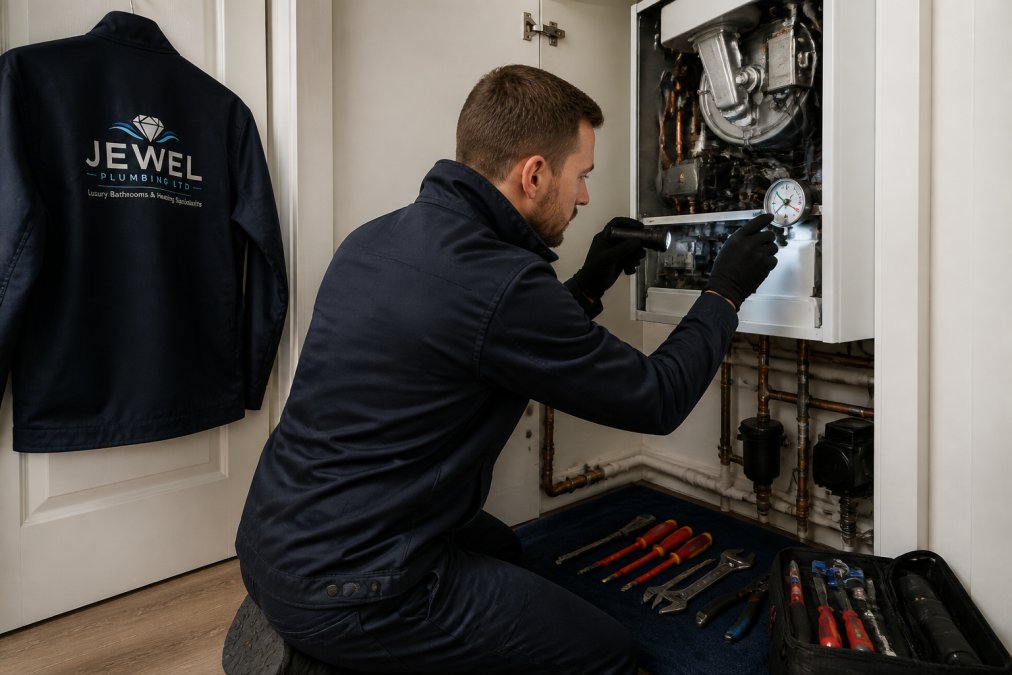
Strange Noises: Banging, Whistling and Gurgling
Banging usually points to trapped air or a failing pump. Whistling often means limescale has built up on the heat exchanger, which is common in hard water areas. Gurgling is nearly always air in the system.
A noisy boiler is not just annoying. Left alone, trapped air and limescale make the boiler work harder, which shortens its life.
Leaks, Drips and Low Pressure
Water where it should not be is the clearest of all the signs your boiler needs professional repair. Check the pressure gauge: most boilers sit between 1 and 1.5 bar when cold.
If you top it up and it drops again within days, you have a leak or a failed component. Stop topping it up and call someone.
Signs of Carbon Monoxide Leak: When to Act Immediately
Carbon monoxide has no smell and no colour, which is exactly why it kills. If you suspect a leak, turn the boiler off, open windows, leave the property, and call the National Gas Emergency Service on 0800 111 999.
Never wait to see if symptoms pass. Never restart the boiler to "check".
Watch for these signs:
- Yellow or orange flames instead of a crisp blue
- Black sooty marks around the boiler
- A pilot light that keeps going out
- Condensation on windows in a room with the boiler
- Headaches, dizziness or nausea that ease when you leave the house
Yellow or Orange Flames Instead of Blue
A healthy gas flame burns blue. A yellow or orange flame means the gas is not burning properly, so carbon monoxide may be present.
This is not a "get to it next week" problem. It is a same-day emergency.
Why Your Boiler Needs a Gas Safety Cert and Annual Service
A gas safety cert is a record confirming that a gas appliance has been checked and found safe by a Gas Safe registered engineer. Landlords must have one for every gas appliance in a rented property, renewed every 12 months.
For homeowners, an annual service is not a legal requirement, but it is the single best way to catch small faults before they become expensive ones.
A service typically covers:
- Flue and combustion checks
- Pressure and gas rate testing
- Cleaning of key components
- A written report on the boiler's condition
Gas Safe Register guidance for homeowners
Boiler Service Cost: What Affects the Price You Pay
There is no single figure for boiler service cost. It depends on the boiler type, its age, how accessible it is, and whether the engineer finds anything that needs fixing.
Prices also vary by region and by provider, so any quote you see online is a starting point at best.
What moves the price up or down:
| Factor | Effect on Cost |
|---|---|
| Boiler type and age | Older or combi units take longer |
| Accessibility | Tight cupboards add time |
| Parts needed | Faults found add to the bill |
| Emergency call-out | Out-of-hours visits cost more |
| Location | Regional rates differ |
Repair or Replace? How to Decide
Repair wins when the boiler is under ten years old, the fault is isolated, and repairs cost far less than a new unit. Replacement makes more sense when the boiler is old, breaking down often, or facing a large repair bill.
Use this rough rule:
- Under 10 years old, one clear fault: repair
- Over 15 years old, repeated faults: consider replacing
- Repair costing a large share of a new boiler: replace
- Parts hard to source: replace
When to Call a Professional: Emergency vs Routine
Call immediately for gas smells, carbon monoxide signs, no heating in cold weather, or water pouring from the unit. Book a routine visit for noises, slow pressure drops, or an annual service.
Work on a gas boiler is legally restricted to Gas Safe registered engineers. Anything involving the gas supply, the flue or the combustion chamber is not a DIY job.
Frequently Asked Questions
What are the most common signs your boiler needs professional repair?
The clearest signs include banging, whistling or gurgling noises, a yellow rather than blue flame, water pooling beneath the unit, pressure that keeps dropping, and radiators that stay cold at the bottom. If your boiler locks out repeatedly or shows a fault code you cannot clear, that also points to a repair rather than a reset. Any of these symptoms can worsen quickly, so book a Gas Safe registered engineer rather than waiting for a full breakdown.
How often should a boiler be serviced by a Gas Safe engineer?
An annual service is the standard recommendation for every gas boiler, regardless of age or brand. The service checks combustion, flue integrity, pressure and safety devices, and it keeps your manufacturer warranty valid. If you rent out a property, a gas safety cert is a legal requirement every 12 months. Servicing also gives an engineer the chance to spot early wear before it becomes an expensive repair.
Can I fix a boiler problem myself or do I need a professional?
You can safely repressurise a boiler using the filling loop and reset it once if the manufacturer's manual allows. Anything involving the gas supply, the combustion chamber, the flue or internal components must be handled by a Gas Safe registered engineer. Working on a gas appliance without registration is illegal and dangerous. If a reset does not solve the fault, or you smell gas, stop and call a professional.
What does a yellow flame on a boiler indicate?
A healthy gas flame burns blue. A yellow or orange flame usually means incomplete combustion, which produces carbon monoxide. Other warning signs include black sooty marks around the boiler, a lazy flame that lifts away from the burner, and condensation on nearby windows. If you see any of these, turn the boiler off, open windows, and call the National Gas Emergency Service on 0800 111 999 before contacting an engineer.
Boiler problems rarely fix themselves, and the ones that matter most are the ones you cannot see or smell. At Jewel Plumbing, our heating specialists handle everything from routine servicing to emergency call-outs across the West Midlands, backed by our 5-star rated service and a team that treats your home with care. Get started with Jewel Plumbing and keep your heating reliable all year.